Choosing a Decision Model Means Choosing an Operating Boundary
A comparison of Jev and Laya illustrates the practical choice between a managed decision API and an open-weight model: ownership, data boundaries, calibration, and workload-specific tests matter more than a single benchmark rank.


Choose a decision model by testing its full operating boundary—data handling, label quality, calibration, latency, cost, and ownership—not by transferring one benchmark rank directly into production.
Some AI workloads do not need a paragraph of generated text. They need a typed decision: assign a support queue, select an allowed action, or return one label from a defined set. A September 24 community comparison frames this design choice through Jev, a managed decision API, and Laya, an open-weight model that can be run and adapted locally.
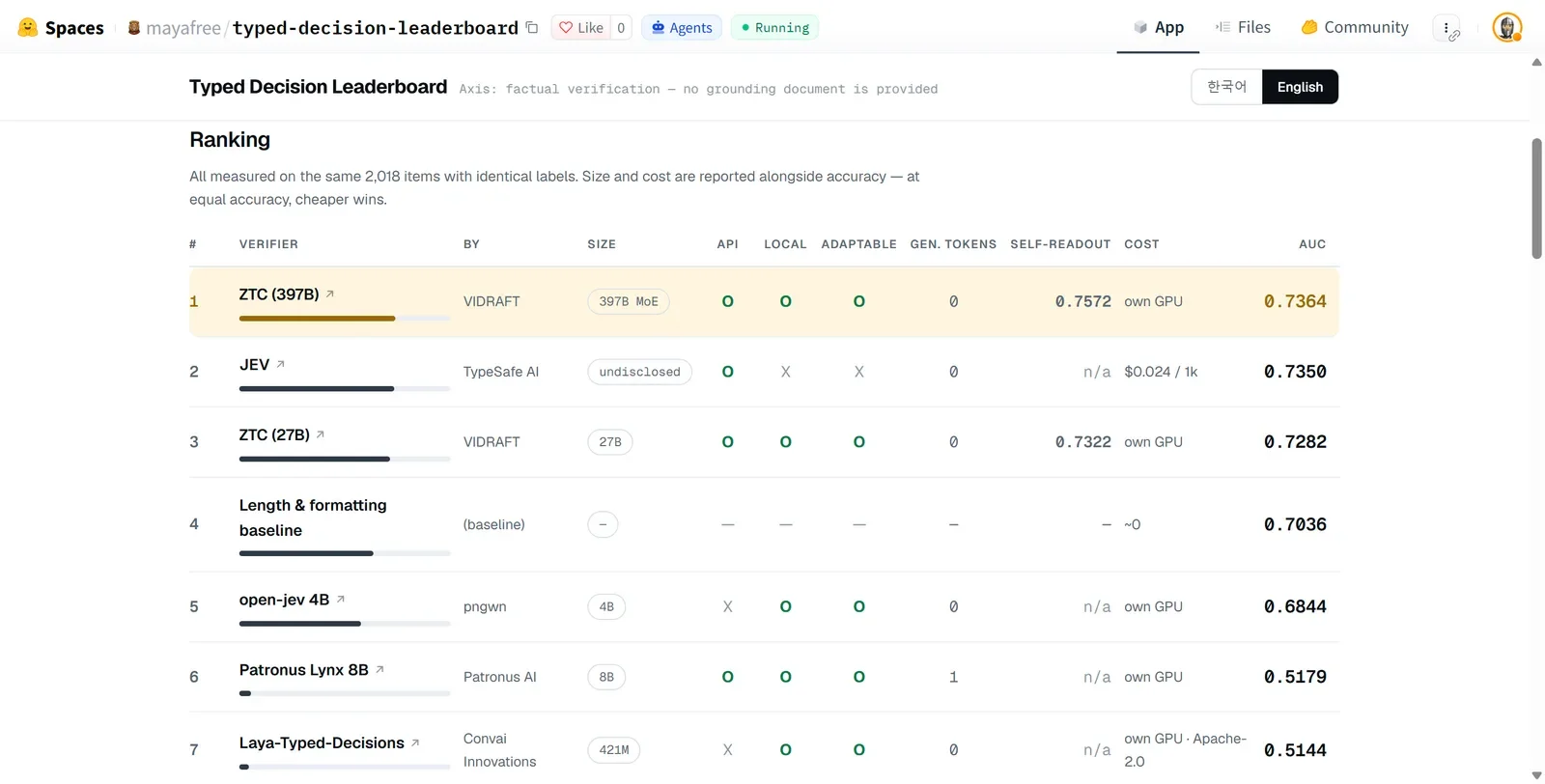
The source reports that Jev led its JevBench v1.3.0 configuration, scoring 74.4 overall against Laya's 54.4 across 534 decisions. It also describes materially different operating envelopes: the tested Jev service accepts much longer inputs, while the evaluated Laya checkpoint uses 512 tokens per question. Those figures describe particular versions and a particular benchmark. They do not settle whether an API or a self-hosted checkpoint is the better component for a given product.
Start with the boundary the system must respect
The first question is not which row is higher. It is where inputs, model execution, and operational responsibility may live. A hosted service transfers provisioning, updates, and much of serving reliability to a provider. That can shorten the path from prototype to a stable endpoint, especially when a team does not already operate accelerators. It also introduces a network dependency and requires an acceptable policy for sending request data outside the application's own infrastructure.
Open weights reverse much of that arrangement. Keeping inference inside a controlled environment can support residency requirements and deeper adaptation, but the operator inherits capacity planning, observability, upgrades, and incident response. Merely downloading a checkpoint does not produce a reliable service. Teams need to account for batching, saturation, model loading, rollback, and the staff time required to maintain them.
Write these constraints before comparing quality. Include maximum input length, permitted data paths, expected concurrency, recovery objectives, update control, and whether training examples exist. A candidate that violates a mandatory boundary should not advance because it wins an average benchmark.
Turn labels into a real product contract
A typed decision is only dependable when its label schema is precise. Define each label, tie-breaking rules, and an explicit outcome for insufficient evidence. If two queues overlap or reviewers cannot agree on what “allowed” means, the model is being asked to automate an unresolved policy.
Build examples from the intended workflow rather than translating a public benchmark score directly into an adoption decision. Include routine cases, rare but expensive mistakes, ambiguous inputs, malformed records, and examples near every label boundary. If production inputs contain long documents, place the decisive detail near the end and verify that truncation does not remove it. If multiple languages matter, evaluate each language and domain vocabulary separately instead of treating multilingual support as a binary feature.
Keep a held-out set that remains untouched while prompts, fine-tuning data, or schemas are revised. For open weights, compare the base checkpoint and any adapted version on exactly the same split. For an API, pin the available model version where possible and record when provider-side changes occur. This makes a regression attributable rather than mysterious.
Evaluate confidence as a routing signal
A confidence value becomes useful only after it is connected to an action. A high-confidence decision might proceed automatically, a middle band might enter human review, and a low-confidence case might abstain or request more information. The thresholds should follow the cost of errors, not a convenient round number.
Measure calibration on production-like data: among decisions assigned similar confidence, how frequently are they correct? Report coverage alongside accuracy because a system can improve accuracy on answered cases simply by abstaining more often. Also break out false accepts and false rejects. Their consequences can be sharply different even when they contribute equally to an aggregate score.
Recheck calibration after fine-tuning, quantization, prompt changes, schema revisions, or model upgrades. A threshold chosen for one version is not automatically valid for the next. Human-review capacity belongs in this test as well; an apparently cautious threshold may fail operationally if it sends an unmanageable share of traffic to reviewers.
Compare the complete service, not isolated timings
Latency claims measured on different hardware and serving paths are not interchangeable. Test both candidates from the application boundary, including serialization, network time, queueing, cold starts, and retries. Record p50 and p95 latency under realistic concurrency, plus throughput and failure rates. A fast single request says little about behavior during a burst.
Cost comparisons need the same scope. Put API charges beside accelerator capacity, idle time, engineering work, monitoring, storage, and upgrade testing. Self-hosting can be economical when capacity and expertise already exist; it can be costly when a small workload requires dedicated infrastructure. Conversely, predictable API integration can carry usage or dependency costs that become important at scale.
A short shadow run provides the strongest final check. Send representative live inputs to both systems without allowing either to trigger consequential actions, then have reviewers inspect disagreements and uncertain cases. The outcome may favor a managed API, an adapted local model, or a hybrid fallback. The important result is not declaring a universal winner. It is selecting the operating boundary whose measured behavior, ownership burden, and failure policy fit the product.
Source: Jev vs Laya: Hosted API or Open Weights? (2026 Guide) ↗. How we write